
In this article
Medically reviewed by [Author Name], [Credential — e.g., RN, PA-C, or MD], Lead Injector at Mediversity Health. Last updated July 2026.
If you’ve been scrolling through before-and-after photos wondering whether you need Botox, filler, or both, you’re not alone. It’s one of the most common questions patients bring into consultations here at Mediversity Health, and for good reason — the two treatments look similar on the surface (a quick injectable appointment, minimal downtime, natural-looking results) but they work in completely different ways.
Whether you’re in Hoboken, Jersey City, Newark, Edison, or anywhere else across Bergen, Essex, Hudson, or Middlesex County, this guide breaks down exactly what each treatment does, how long it lasts, what it costs, and how to figure out which one fits your goals. In our experience treating patients across New Jersey, most first-time visitors arrive with one treatment in mind and leave with a plan that actually addresses both movement and volume — which is exactly what this guide will help you figure out for yourself.
The Core Difference: Movement vs. Volume
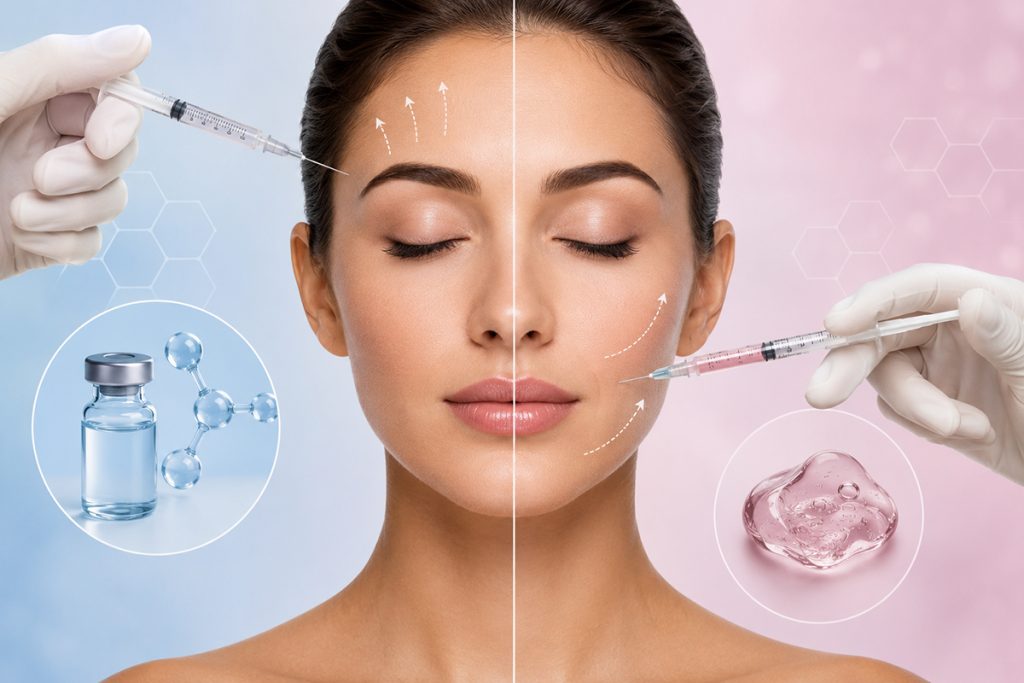
The easiest way to understand Botox vs. fillers is to think about what is causing the line or wrinkle you’re trying to soften.
Botox (and other neuromodulators) works by temporarily relaxing the facial muscles responsible for repetitive expressions — frowning, squinting, raising your eyebrows. These are called “dynamic wrinkles” because they only show up when your face moves. By calming the muscle activity underneath, Botox smooths the skin above it. Botox is FDA-approved for cosmetic use in specific facial areas, and its safety and mechanism of action are well documented by the FDA.
Dermal fillers, on the other hand, are gel-based substances (most commonly made from hyaluronic acid, a substance your skin already produces naturally) that are injected directly beneath the surface to add volume. Fillers don’t touch muscle activity at all — instead, they plump up areas that have thinned, hollowed, or sagged, whether that’s from aging, volume loss, or simply wanting more definition in the lips or cheeks. The American Society of Plastic Surgeons notes that modern hyaluronic acid fillers are considered a safe, well-studied option when administered by a qualified provider.
In short: Botox treats how your face moves. Fillers treat how your face is shaped.
Where Each Treatment Works Best
Botox is typically the go-to for:
- Forehead lines
- Frown lines between the eyebrows (the “elevens”)
- Crow’s feet around the eyes
- A gummy smile or lip flip (used more subtly)
- Jaw slimming or TMJ-related tension (masseter treatment)
Fillers are typically the go-to for:
- Hollow or flattened cheeks
- Thinning lips or asymmetry
- Nasolabial folds (the lines running from nose to mouth)
- Under-eye hollows or tear troughs
- Jawline and chin contouring
- Restoring overall facial volume lost with age
Many patients don’t actually have to choose one or the other. A combined approach, sometimes nicknamed a “liquid facelift,” pairs Botox in the upper face with strategic filler placement elsewhere for a refreshed look that doesn’t read as “done.” At Mediversity Health, this is one of our most requested treatment plans because it addresses both muscle movement and volume loss at once — see our full Botox treatment page and dermal filler treatment page for a closer look at each service.
Botox vs. Fillers: How Long Do Results Last?
This is usually the deciding factor for a lot of our New Jersey patients, since it directly affects how often you’ll need to come back in.
Botox results generally last three to four months before the muscle activity gradually returns and touch-ups are needed. Fillers last considerably longer — most hyaluronic acid fillers hold up for six months to about two years, depending on the product used, the area treated, and how quickly your body metabolizes it. Denser areas like the cheeks or jawline tend to hold filler longer than higher-movement areas like the lips.
Neither treatment is permanent, which is actually one of the appeals for a lot of first-time patients — if you don’t love the result, or your aesthetic goals change, both treatments fade naturally over time rather than locking you into a permanent change.
What About Cost?
Pricing varies by provider, dosage, and the specific product used, but generally speaking:
- Botox is priced per unit, and most treatment areas require somewhere between 20 and 60 units. It has a lower cost per visit, but because it wears off faster, you’re budgeting for more frequent maintenance appointments throughout the year.
- Fillers are priced per syringe, with most patients needing one to three syringes per session. The upfront cost per visit is higher, but since results last so much longer, the annual cost can end up comparable — sometimes even lower — than maintaining Botox.
During a consultation at Mediversity Health, we’ll walk you through a personalized cost breakdown based on your specific goals so there are no surprises.
Is There a “Right” Age to Start?
There isn’t a universal starting age for either treatment — it really comes down to your facial anatomy and what you’re hoping to address, not a number on a calendar. Botox is often introduced earlier, sometimes in the late 20s or early 30s, as a preventive step to soften expression lines before they become etched in. Fillers tend to become more relevant later, once volume loss starts changing the contours of the face. That said, plenty of patients in their 20s use filler for lip enhancement or jawline definition, and plenty of patients in their 50s and 60s rely primarily on Botox. It’s about your goals, not your birth year.
Recovery and What to Expect
Both treatments are minimally invasive, done in-office, and require little to no downtime — most patients head straight back to work or their normal routine afterward. A few things to know:
- Botox results appear gradually, typically within 3–7 days, and fully settle in around two weeks.
- Fillers show results immediately, though some settling and mild swelling is normal for the first 1–2 weeks.
- Minor bruising or swelling at the injection site is common with both and usually resolves within a few days.
Who Should Be Cautious or Avoid These Treatments
Botox and dermal fillers are considered safe for most healthy adults, but they aren’t right for everyone. You should talk to your provider before treatment, and treatment is generally not recommended, if you:
- Are pregnant or breastfeeding
- Have a known allergy to any ingredient in the specific product being used (including, for some fillers, lidocaine)
- Have an active skin infection or inflammation in the treatment area
- Have certain neuromuscular conditions (for Botox specifically)
- Are currently taking blood thinners, which may increase bruising risk
This isn’t a complete list — it’s exactly why a proper in-person consultation and medical history review matters before any injectable treatment. At Mediversity Health, every new patient completes a health history review with a licensed provider before any treatment is administered.
Frequently Asked Questions
Can I get Botox and filler in the same appointment? Yes. It’s common to combine both in a single visit, and many providers recommend it for patients who have both dynamic wrinkles and volume loss. Your provider will sequence the treatments appropriately.
Is Botox or filler more painful? Both are generally well tolerated. Most fillers include a numbing agent (like lidocaine) mixed directly into the product, which tends to make the injection more comfortable than Botox, though discomfort for either is typically brief and mild.
Will people be able to tell I got Botox or filler? When administered conservatively by an experienced injector, results should look natural rather than obviously “done.” This is one of the biggest reasons injector experience matters more than the specific product used.
What happens if I stop getting Botox or filler? Your face will gradually return to how it looked before treatment as the product wears off. There’s no rebound effect or worsening of wrinkles from stopping.
How do I know which treatment I actually need? The only reliable way is an in-person consultation, where a provider can assess your specific anatomy, movement patterns, and volume loss to build a plan — which is exactly what we do at Mediversity Health.
Choosing What’s Right for You
If your main concern is expression lines that show up when you smile, frown, or squint, Botox is likely your starting point. If you’re noticing volume loss, hollowing, or want to enhance features like your lips or jawline, fillers are probably the better fit. And if you’re dealing with a mix of both — which is extremely common — a combination treatment plan can address everything in one cohesive strategy.
The best way to know for sure is a proper consultation with an experienced injector who can assess your facial anatomy and talk through your goals in person.
Book a Consultation with Mediversity Health
At Mediversity Health, we take the time to build a treatment plan around your face, not a one-size-fits-all approach. Serving patients throughout New Jersey — including Turnersville, Hoboken, Jersey City, Newark, and Edison — our licensed team can help you decide whether Botox, filler, or a combination approach will get you the natural, refreshed look you’re after.
📍 [4991 Route 42 Suite 8, Turnersville, NJ, United States, 08012] 📞 (856) 740-9777 🔗 [Book Online / Booking Link]